The Radeon HD 4850 X2 coming from the biggest manufacturer of ATI based graphic solutions comes with two ATI HD 4850 graphic chips which are clocked at 625 MHz and supported by GDDR3 Memory at a clockrate of 1000 MHz. Because of the sheer size of the cooling solution the card comes with a dual slot design.
Tuesday, January 20, 2009

Sunday, January 18, 2009
Intel 5-Series Chipset Lineup Detailed
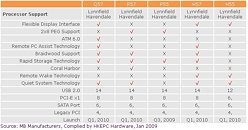
Now faced with delays, Intel's upcoming Ibex-Peak platform, a next-generation mainstream implementation of the Nehalem architecture, is an interesting mix of technologies, where Intel seeks to minimise the platform and energy footprints while delivering value and performance though a clever bit of rearrangement of system components. HKEPC has learned that Intel's 5-Series mainstream chipsets consists of five models: P57, Q57, H57, P55, and H55. The P57 and P55 are built for the consumer PC with discrete graphics. The H57 and H55 chipsets are built for processors with integrated graphics, with support for the Intel FDI. The Q57 is built for the business / enterprise-client PC, it supports a host of exclusive Intel technologies that make the machine easier to manage.
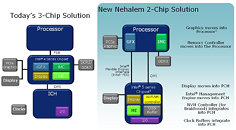
With Intel's upcoming Lynnfield quad-core and Havendaledual-core
processors go a step beyond merely housing the memory controllers. They now also integrate PCI-Express root complexes, and some models even feature integrated graphics controllers on-die. This completely eliminates the requirement of a northbridge, leaving a southbridge to handle storage and peripherals. What this design does is that it eliminates a system bus between the CPU and the motherboard, with the components housed in the CPU having an internal QuickPath Interconnect linking all components, which aims to bring down latencies. The only connections the processor ends up having with the motherboard would be the PCI-Express lanes, a DMI connection to the southbridge, connections for the dual-channel DDR3 memory, and for processors with IGPs, a separate connection called Intel Flexible Display interface that routes the IGP to its I/O via the southbridge. The processor uses the newer LGA-1160 socket.
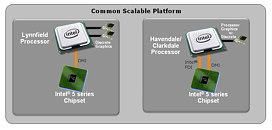
The PCI-Express root complex the processors come with can support up to two graphics cards with 8 PCI-Express 2.0 lanes each, or a single graphics card with full-bandwidth 16 lanes. The ATI CrossFireX multi-GPU technology is supported, while SLI support isn't known as yet. While 8 PCI-E 2.0 lanes to drive today's powerful GPUs sounds like a cause for concern, later down the line, one can expect motherboard vendors work around this bottleneck using PCI-E multiplex chips such as theNVIDIA BR-03, that provide full x16 connections to each graphics card, and attempt to boost performance using data-broadcast functions. All models of the 5-series PCH chipsets support six SATA II connections, and as many as 14 USB 2.0 ports. The 5-series chipset launch schedule spans from Q3 2009 to Q1 2010, though with news emerging of delays in the launch schedule, these could be pushed further away, maybe into 2010 altogether.


With Intel's upcoming Lynnfield quad-core and Havendale


The PCI-Express root complex the processors come with can support up to two graphics cards with 8 PCI-Express 2.0 lanes each, or a single graphics card with full-bandwidth 16 lanes. The ATI CrossFireX multi-GPU technology is supported, while SLI support isn't known as yet. While 8 PCI-E 2.0 lanes to drive today's powerful GPUs sounds like a cause for concern, later down the line, one can expect motherboard vendors work around this bottleneck using PCI-E multiplex chips such as the
GT300 A Leap Forward for NVIDIA GPU Architecture
Every once in a while, comes a GPU by NVIDIA that marks the evolution of GPU architecture for NVIDIA. A good example of this would be the G80, which was a distinct evolution of the GPU architecture for the company. Sources tell Hardware-Infos that the GT300 is on course of being one such GPU that comes with distinct architectural changes. To begin with, GT300 will start the company’s DirectX 11 conquest the way its ancestor, the G80 did for DirectX 10, which turned out to be largely a successful one.
The GT300’s architecture will be based on a new form of number-crunching machinery. While today’s NVIDIA GPUs feature a SIMD (single instruction multiple data) computation mechanism, the GT300 will introduce the GPU to MIMD (multiple instructions multiple data) mechanism. This is expect to boost the computational efficiency of the GPU many-fold. The ALU cluster organization will be dynamic, pooled, and driven by a crossbar switch. Once again, NVIDIA gets to drop clock-speeds and power consumptions, while achieving greater levels of performance than current-generation GPUs. With GT300, NVIDIA will introduce the next major update to CUDA. With the new GPUs being built on the 40nm silicon fabrication process, transistor counts are expected to spiral-up. NVIDIA’s GT300 is expected to go to office in Q4 2009, with its launch schedule more or less dependent on that of Microsoft’s Windows 7 operatingsystem that brings in DirectX 11 support.

The GT300’s architecture will be based on a new form of number-crunching machinery. While today’s NVIDIA GPUs feature a SIMD (single instruction multiple data) computation mechanism, the GT300 will introduce the GPU to MIMD (multiple instructions multiple data) mechanism. This is expect to boost the computational efficiency of the GPU many-fold. The ALU cluster organization will be dynamic, pooled, and driven by a crossbar switch. Once again, NVIDIA gets to drop clock-speeds and power consumptions, while achieving greater levels of performance than current-generation GPUs. With GT300, NVIDIA will introduce the next major update to CUDA. With the new GPUs being built on the 40nm silicon fabrication process, transistor counts are expected to spiral-up. NVIDIA’s GT300 is expected to go to office in Q4 2009, with its launch schedule more or less dependent on that of Microsoft’s Windows 7 operating
Intel Postpones the Launch Schedule of Lynnfield CPUs and P55 Chipset
I'm afraid that what's to be told here, is hard to be categorized as good news. Industry observer DigiTimes reports that Intel is about to postpone the initiation of Lynnfield processors and P55 chipset. Chips based on the quad-core Lynnfield design, are supposed to bring Nehalem to more people, because they'll represent the budget line of Core i7 processors.
Intel has recently decided to postpone its next-generation mainstream CPU Lynnfield along with the P55 chipset to the end of August or the beginning of September this year, and may postpone them to an even later time depending on the market situation, according to sources at motherboard makers. Both Lynnfield and P55 were originally scheduled to launch by the end of July. The economic decline which has caused motherboard makers to suffer overstocked chipset inventory is the major reason for the pull back, according to the sources. After the P55 launches, Intel plans to phase out non-IGP P45 and P43 chipsets and will transition its 4-series IGP chipsets to the entry-level.
Intel has recently decided to postpone its next-generation mainstream CPU Lynnfield along with the P55 chipset to the end of August or the beginning of September this year, and may postpone them to an even later time depending on the market situation, according to sources at motherboard makers. Both Lynnfield and P55 were originally scheduled to launch by the end of July. The economic decline which has caused motherboard makers to suffer overstocked chipset inventory is the major reason for the pull back, according to the sources. After the P55 launches, Intel plans to phase out non-IGP P45 and P43 chipsets and will transition its 4-series IGP chipsets to the entry-level.
SAMSUNG SYNCMASTER T240 24 INCH LCD MONITOR
PRODUCT INTRODUCTION

Buying an LCD monitor in today's market is more like going to a grocery store rather than a specialty purchase only a few short years ago. With a selection that can and will confuse even the most seasoned tech aficionado, where does one start? How to your hone down the choice to the one you want?
To simplify things today, the Syncmaster T240 being reviewed today would not be average consumer's pick as an introductory model. It is larger than most consumer's need, has additional functionality such as full 1920x1200 resolution, HD HDMI connectivity, includes a USB 2.0 hub and does all this while keeping the price very competitively set at about US$350.
But is this monitor worth skipping the introductory smaller LCD monitor step and get a decent large LCD monitor right from the start and not worrying about upgrading later? Does this large monitor game well and how does this monitor perform after extended testing over several months?
What can TFT LCD Technology do for me?
Below is just a small list of what TFT LCD technology can do for your small business or home environment.
1.) Radiation - TFT LCD technology virtually eliminates radiation which is emitted from normal CRT monitor and can promote a healthier computing environment for your children at home and/or your work environment.
2.) Low Power Consumption - LCD monitors have a power consumption of about half of the equivalent CRT monitors.
3.) Colour - Colours on LCD's are much more vibrant that CRT monitors.
4.) Physical Size - One of the main advantages is the size difference. LCD monitors cover about 30% of the desk area than a standard CRT.
5.) Viewable Area - Now here is the kicker, if you buy a 17" CRT monitor, it's safe to say that you will have an actual viewing area of about ~16". Now, when a TFT LCD is said to be 17", the viewable area IS 17", which is a far more honest approach to marketing.
Xbox 360 Sells Better Than PlayStation 3
According to Microsoft, its own Xbox 360 console has sold over eight million more units than the Sony PlayStation 3. Worldwide, this brings the total number of Xbox 360 units purchased to a total of twenty-eight million. While it is outselling the Sony console in the United States, the Xbox 360 is also selling more units in the United Kingdom, by a margin of one million units. The Nintendo Wii however is outselling both of these next generation consoles, since in the United Kingdom alone it has sold three million units, and the United States has seen a staggering number of over ten million units as well.
ASUS P6T6 WS Revolution Workstation Motherboard:Multi-GPU Solutions and Revolutionary High Speed I/O for Optimal Flexibility
The ASUS P6T6 WS Revolution is the ideal foundation for a powerful workstation for Small Office usage, SOHOs and mainstream workstation users; with its unparalleled performance. Through ASUS’ revolutionary and innovative design, the P6T6 WS Revolution is able to support three true x16 link PCI-E slots for NVIDIA's 2-way & 3-way SLI™ and ATi CrossFireX™ technologies to deliver extreme graphical processing performance. Furthermore, it is also equipped with 6 PCI-E Gen2 x16 slots onboard to provide users with high speed I/O and flexible graphic and computing options.

Three True x16 Link PCI-E for 3-way SLI and CrossFireX on Demand
The P6T6 WS Revolution comes equipped with built-in 3-way SLI/CrossFireX on Demand technology for outstanding graphical performance. This revolutionary technology allows users to enjoy 2-way / 3-way SLI™ technology or CrossFireX™ support on the same motherboard. This means that users will be able to install up to three 3-Way SLI-capable graphics cards and retain the flexibility to run a CrossFireX setup. Whichever option they choose, users are guaranteed mind-boggling graphics performance for improved work efficiency. It can also support true @16 PCI-E Gen2 3-Way SLI technology, which will present the fastest and the most reliable graphic performance to users whether they are engaged in Mechanical/ Architecture/ Interior/ Aircraft/ Audio/Video Design or playing games in their leisure time.

Revolutionary 6 High Speed PCI-E Gen2 x16 Slots
The P6T6 WS Revolution is equipped with 6 PCI-E Gen2 x16 Slots to provide customers with high speed I/O options. Each slot will support up to 8GB/s of bandwidth, which is double the bandwidth when compared to PCI-E 1.1—suitable for high speed Infiniband connections, professional graphic or high-performance computing cards. With 6 PCI-E Gen2 x16 slots, users will have sufficient I/O interfaces to fulfill their demands of any high-end graphic or high-performance computing solution. With the ability to run both types of multi-GPU setups with the SLI/CrossFire on Demand technology, users can utilize up to three graphics cards in a 3-Way SLI or CrossFireX configuration to ensure astonishingly smooth graphics.
Multitude of Storage Options with Cutting-edge SAS
The P6T6 WS Revolution provides users with onboard SAS (Serial Attached SCSI) ports that supports hard drive upgrade flexibility; and retains full compatibility with the ASUS optional SASsaby card. Faster, safer and more stable, SAS hard disks will provide higher data transmission speeds and better data storage reliability in comparison to current SATA interfaces; and will provide users with a better choice for storage expansion and upgrade needs.
Industry-leading Power Design
The breakthrough 16+2 power design (16-phase to vCore; 2-phase to vDRAM/QPI controller inside CPU) technology is able to: achieve high power efficiency; effectively dispel heat generated by the VRM module, and lower temperatures better in comparison to other VRM solutions. With high quality power components such as: low RDS (on) MOSFETs, Ferrite core chokes with lower hysteresis loss, and 100% Japan-made high quality conductive polymer capacitors, the ASUS 16+2 phase VRM design also ensures longer component life, minimum power loss, and helps to reach higher overclocking scores than ever before.
Enjoy Working with WS Diag. LED and the "ASUS Heartbeat"
Working with the ASUS workstation can now be enjoyable and interesting. During bootup, the Diag. LED will check key components (CPU, DRAM, VGA card and HDD) sequentially; and if an error is found, the LED next to the error device will remain lit until the problem is solved. Once it has successfully booted up, the LEDs around the ASUS brand name on the motherboard will glow brightly and vividly with a deep-blue light according to a regular tempo—much like the steady rhythm of deep breaths—making the workstation board seem like it is "coming to life".
Surfing the Internet within 5 Seconds* via Express Gate
This additional built-in Operating System makes a host of commonly used applications available to users in just 5 seconds from bootup; including the web browser, instant messenger, Skype, photo manager, music player and online games. With this convenient, instant access to the Internet, users can now send a last-minute email before rushing off to work, browse the Web in between appointments and reach friends and family via the instant messenger all in the blink of an eye.
* Actual boot time is subject to hardware configurations and product models
Practical Features for Efficient Work Solutions
The P6T6 WS Revolution also comes with an additional G.P. Diagnosis card. This useful tool helps provide quick and precise system checks, and displays errors on the LED display—helping users to pinpoint errors quickly. Connected on the TPM header, the G.P. Diagnosis card also provides great convenience by being near the onboard reset and power buttons for easy troubleshooting.
World Record for Core i7 CPU Frequency Broken at 5510.09MHz!
The release of the Intel® Core™ i7 has set the overclocking arena abuzz with excitement in anticipation of new world records. Armed with the ASUS ROG Rampage II Extreme motherboard that supports the newest Intel platform, the Japanese overclocking enthusiast duck smashed to the top of the overclocking charts and notched in a world record for Core i7 CPU frequencies. He managed to record an exceptional score of 5510.09 MHz—clearly laying down the gauntlet to future challengers to the throne. A veteran of overclocking CPUs, duck still holds the world’s highest frequency for overclocking a Pentium 4 631 CPU to a staggering 8180.4MHz last year.

 The successful breaking of the world record was in no small part thanks to the overclocking-oriented features found on the new Rampage II Extreme motherboard. TweakIt, an easy-to-use joystick-like control on the motherboard, enables overclockers to make real-time changes to their systems’ core frequency, voltage and other parameters—even while the benchmark utility is running. At no point does software come into play, as the tweaking is completely hardware-based. With such hassle-free tweaking, coupled with information like the system frequency relayed to overclockers in real-time via the LCD Poster, changes could be on-the-fly during CPU tests and result in extraordinary benchmark scores.
ASUS Adds ROG EAH4870 MATRIX and EAH4850 MATRIX to its Lineup of the World's Most Intelligent Graphics Cards
ASUS, the world's leading producer of top-quality graphics solutions, today unveiled the ASUS Republic of Gamers (ROG) EAH4870 MATRIX/HTDI/512MD5 and EAH4850 MATRIX/HTDI/512M graphics cards; which sport the Radeon™ HD 4870 and 4850 GPU respectively. These world's most intelligent cards are equipped with ROG-exclusive technologies and features that unleash the full power of graphics cards, allowing gamers to enjoy an unrivaled in-game visual experience. They achieve this through several unique features, including:
- Integrated hardware and software for total graphics card control
- Customizable functions that provide a new level of control to gamers
- Twin fan control application to separately adjust Hybrid Cooler+ fans (for EAH4870 MATRIX)
- Accurate adjustments of GPU and memory voltages
- Complete monitoring of GPU/memory/Power IC/ambient temperatures
- Complete monitoring of GPU/memory/board power consumption
- Automatic control of fan speeds according to the world's only advanced GPU loading detection
- Energy efficiency that surpasses generic boards

The Perfect Answer to Gaming Needs
Boasting a stylish design that comprises daring lines, a futuristic Hybrid Cooler and a black circuit board, the ASUS ROG EAH4870 MATRIX and EAH4850 MATRIX can instantly be identified as pieces of top-notch gaming hardware. The ROG logo prominently emblazoned on the cooler is a mark of ROG's promise that these graphics cards will deliver extreme gaming performance. Both cards are equipped with the ASUS Super Hybrid Engine, Hybrid Cooler technology and iTracker, enabling 15% and 17% performance boosts in 3D mode while guaranteeing 54% and 28% less power consumption and much quieter cooling in 2D mode— fulfilling the varied needs of gamers.
Auto Hardware Detection and Adjustments with Super Hybrid Engine
ASUS' exclusive Super Hybrid Engine (SHE) technology showcases its intelligence via a two-fold process. First gathering detailed information about the GPU loading and temperature, memory and power IC; SHE then calculates an optimized solution for the best performance. All of this happens in real time, without requiring any tinkering from users—making it easy to achieve multi-level GPU and memory voltage adjustments for the ultimate graphics performance or maximum energy savings.
Hybrid Cooler for Auto-managed Proactive Cooling
The most intelligent and innovative GPU thermal solution today, Hybrid Cooler draws its inspiration from Hybrid cars. By combining the fan and heatsink on one card in a revolutionary way, the Hybrid Cooler delivers its targeted level of performance in the most energy-efficient manner possible. When required, the fan and heatsink will work together for optimum cooling. Fan speeds are automatically determined via the world's only advanced GPU loading detection, providing users with proactive cooling and greater energy efficiency in the event of lower graphics utilization—much like Hybrid cars. In addition, the ASUS ROG EAH4870 MATRIX comes with the dual-fansink Hybrid Cooler+. The dual fansinks take good care of not only the GPU but also the Power ICs and memory modules to prevent overheating. The speeds of both fans are also automatically adjusted to offer extreme cooling under 3D mode—lowering GPU and Power IC temperatures by a whopping 7°C and 12°C in comparison to reference design boards*. On top of this unprecedented cooling capacity, the noise level of Hybrid Cooler+ is only 36dB versus generic designed fansinks that produce 59.3dB—catering to users who require maximum cooling but without excessive fan rotation noise.
iTracker Offers Users One-click Control over Graphics Card Performances
The iTracker feature is a component of ASUS' exclusive SHE technology, and offers four default profiles for gamers who desire one-click control over their graphics card's performance: Optimized Mode, Gaming Mode, Power Saving Mode, and Default mode. This handy application is also able to display real-time graphics card information that includes the GPU/shader/memory clock, GPU/memory voltage, GPU loading, GPU/memory/power IC/ambient temperature, and fan speed—serving as a one-stop, complete system information portal. In addition, the fifth profile—User Defined Mode—enables real-time adjustments to the GPU/shader/memory clock, GPU/memory voltage, and fan speeds to suit different individual requirements.
Up to 17% Faster in 3D Mode
GPU and memory voltages are boosted from 1.265V/1.5V to 1.423V/1.58V; and from 1.245V/1.979V to 1.303V/2.052V respectively when the ROG EAH4870 MATRIX and EAH4850 MATRIX are running in 3D mode. This allows the GPU and memory clock performance of the ROG EAH4870 MATRIX and EAH4850 MATRIX to be boosted from 750MHz/1800MHz to 855MHz/2014MHz; and from 625MHz/1986MHz to 752MHz/2057MHz respectively. Such unprecedented performance upgrades help raise the ROG EAH4870 MATRIX and EAH4850 MATRIX's 3DMark Vantage Extreme Mode score from 3655 to 4195 and from 2910 to 3395—an unbelievable 15% and 17% speed improvement when compared to any other reference designed board***. Gamers can now feel the adrenaline rush afforded by true-to-life graphics performance—only with the ASUS ROG EAH4870 MATRIX and EAH4850 MATRIX.
Up to 54% Power Saved and Quiet Cooling in 2D Mode
In 2D mode, when less power consumption is required, the ROG EAH4870 MATRIX and EAH4850 MATRIX are able to reduce GPU and memory voltages from 1.316V/1.52V down to 1.1V/1.353V; and from 1.245V/1.979V to 1.15V/1.9V respectively for great energy savings. Furthermore, Auto Phase Switch technology optimizes the power supplied by the power phase for maximum power efficiency. In combining the exceptional voltage reduction with Auto Phase Switch technology, the ROG EAH4870 MATRIX and EAH4850 MATRIX's power consumption are lowered from 72.02W to 33.53W and from 51.36V to 36.99V respectively—an astonishing 54% and 28% in power savings when compared to any other reference designed board**. Additionally, both Hybrid Cooler+ and Hybrid Cooler will help reduce fan rotation speeds in 2D mode, allowing users to enjoy much quieter cooling for comfortable computing environments.
ROG Rampage II Extreme Breaks Two 3DMark Vantage World Records
They have only just been released to the market, but the new Intel® Core™ i7 processor and ASUS ROG (Republic of Gamers) Rampage II Extreme have already proven to be a formidable pairing—one of world record-breaking proportions. This was demonstrated in empathic fashion at the recently-concluded DreamHack Winter 2008, where top Swedish overclockers Marcus "Kinc" Hultin and Robert "Crotale" Kihlberg—using the aforementioned hardware—stole the show with a record-setting score of X21996 (Extreme preset) in 3DMark Vantage, Futuremark's authoritative graphics performance benchmark software. They also performed impressively in the Performance and Entry presets, garnering massive scores of P36302 and E69043 respectively. On a separate occasion—armed also with an ROG Rampage II Extreme—Vince "k|ngp|n" Lucido broke the single graphics card world record in the Vantage Performance preset, setting a score of P21607.
To attain their world record-setting scores, these overclockers relied in no small part on their factory overclocked ASUS graphics cards. Kinc and Crotale used three ASUS ENGTX280 TOP graphics cards in a 3-way SLI configuration, while k|ngp|n used a single ASUS EAH4870X2 TOP graphics card. Both world records were set with PhysX disabled.

(Kinc and Crotale's world record-breaking score in the 3DMark Vantage Extreme preset)

(k|ngp|n's world record-setting score in 3DMark Vantage (Performance preset) with a single graphics card)
These world records validate the real-world applicability of the ROG Rampage II Extreme's overclocking-oriented features. Particular credit should be paid to TweakIt, an easy-to-use joystick-like control on the motherboard that enables overclockers to make real-time changes to their systems' core frequency, voltage and other parameters—even while the benchmark utility is running. At no point does software come into play, as the tweaking is completely hardware-based. With such hassle-free tweaking, coupled with the ability to relay information, such as the system frequency, to overclockers in real-time via the LCD Poster, changes can be performed on-the-fly during CPU tests—resulting in improved tweakability and thus extraordinary benchmark scores.
 “After four years of extreme overclocking, TweakIt is the first feature that I feel really changes the dynamics of overclocking," said Marcus "Kinc" Hultin, shortly after achieving the X21996 feat with teammate Robert "Crotale" Kihlberg. “But most important of all, it is a feature that improves 3DMark performance indirectly. Since you can change clocks while running any application, you can use higher CPU frequencies for the less CPU stressing game tests, and then lower it for the CPU tests. We would not have been able to reach X21996 without TweakIt."

Subscribe to:
Posts (Atom)
